Recognition
What can only be felt
Cassandra isn't in this story.
Not everything begins with her.
She may find that mildly disappointing.
This story belongs to a man.
A journalist.
Sensible. Observant. Trained to
distinguish fact from fiction.
An excellent choice, really.
The gods do have a sense of humour.
He once met someone he could never
quite explain.
He tried.
For years, actually.
Some things remained stubbornly
unwilling to become facts.
He remembers her still.
Let's listen.
Twilight of the gods
The setting sun painted the sky in a
breathtaking cascade of colors. The
wine in my glass had dwindled,
and I stretched my legs out, savoring
the warmth. Today, someone asked me
about the greatest
milestone in my life. Without much
thought, I mentioned my wedding, my
career.
Cliches that spill out automatically. But
the true milestone was something else
entirely.
Not an article, not an interview with
some dignitary, not even the exposé on
the pharmaceutical scandal that
launched me among top journalists.
No - she changed everything.
I couldn’t admit this to myself, let alone
explain it to another. Sometimes, my
mind strains to grasp
the staggering truth. For a fleeting
moment, I glimpse the whole picture,
but the impossible slips
back into the dense fog of my
consciousness.
Only then can I go on, unscathed.
Yet now, it all rushes back, vivid as if it
were yesterday. I can almost smell her
scent, feel her skin.
But she was gone, vanishing from my
life as swiftly as she appeared.
Sometimes I wonder if she was ever
truly there.
For a brief second, I hear her voice:
“Didn’t you receive something
wonderful?” A smile tugs at my lips.
She gave me so much, lavish in every
way, generous beyond measure.
More than any heart could
comprehend. More than any soul could
bear.
And still, I miss her - every single
moment, I miss her.
When it began, no love bound us. She
appeared whenever she wished.
Weeks, even months, could pass
without a trace of her.
A phantom, materializing from nowhere
and fading just as fast.
She never explained her absences or
why she didn’t seek me out more often.
When I asked once, she smiled and
said, “But I’m here now.”
That simple truth left me speechless.
She was here, and that was enough.
I knew she didn’t love me - perhaps she
only tolerated me.
But I burned for her, a bright flame,
consumed by longing.
You never knew where you stood with
her. Her mood could shift in minutes.
Often, she was gentle, tender. Her
fingers would brush my face, light as a
feather, soothing like balm. But just as
suddenly, she could turn distant, cold.
Her touches grew stiff, her presence a
mere shell, as if she’d vanished within
herself.
I never learned what sparked these
changes. At other times, she was fire,
surrendering to passion without
restraint. No woman I’ve known gave
herself so fully to desire.
Watching her was pure bliss. Her sighs,
her soft moans.
When we made love, her eyes were
usually closed tight.
But in those rare, precious moments
when she looked into mine, I drowned
in her gaze.
Something in her softened, revealing
depths that shook me.
Lust, yes, but behind it lay boundless
tenderness, ancient wisdom, love in its
purest form.
Every moment of my life, every feeling,
was held in that single second, in her
eyes.
I was a mortal, gazing into something
eternal. Her whispers sent shivers
down my spine,
her voice taking on a timbre that
poured all her passion into delicate
murmurs.
That dark, cedarwood voice warmed
me, as if her words alone could thaw
the world.
Sometimes they flowed endlessly,
melting the ice around my heart.
One evening, when no ice remained,
she, the mistress of contradictions,
asked, “What does love feel like?” I
stammered, fumbling for words.
That’s when I realized I knew nothing of
love. But I felt it. God, I felt it.
I’m certain she understood the weight
of that moment.
She smiled, knowingly, tapped her
fingers on my chest, and said,
“Here’s the answer you’re searching for.”
Then she kissed me, and I sensed our
days together were slipping away, slow
but relentless.
Without her, my life turned gray, lifeless.
She wasn’t a sunny glow that
brightened existence.
No, she was a lens, focusing the sun’s
rays a thousandfold.
That power could burn you to ashes or
raise you, like a phoenix, to impossible
heights.
With her, everything pulsed with life,
and I’d have given anything to hold
onto that feeling.
The thought of losing her tore at my
heart.
A dark heaviness would grip me then.
Yet I couldn’t help but cherish every
second with her, willing time to pause. I
didn’t think of tomorrow; I lived only in
those singular hours.
Hours that held every age of the world.
One morning, unexpectedly, she woke
me early and drove us to the edge of a
small forest.
She said little, and I asked no
questions. I followed in silence, sensing
something was different.
We reached a clearing. Morning light
wrapped her perfectly, and she
shimmered, radiant in the truest sense.
Golden beams seemed to pulse
through her, bursting from within.
Her eyes blazed with an intensity I’d
never seen. The forest lived in those
eyes.
For a fleeting moment, I saw her in a
white dress, a woodland nymph or
some ancient deity.
It was unsettling. I blinked, but the
radiance held.
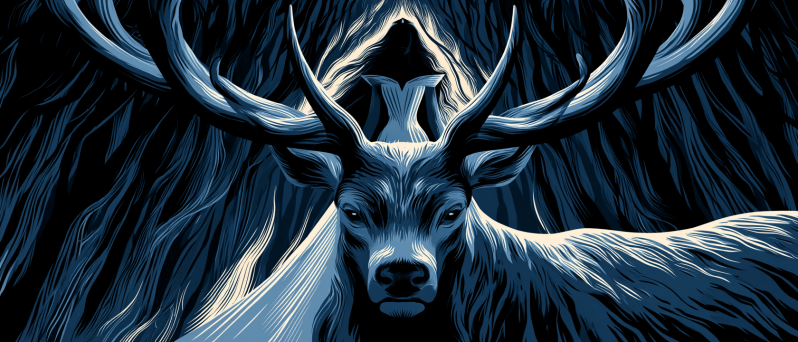
A great stag stepped into the clearing.
It strode majestically across the
meadow, its towering antlers catching
the first rays of the rising sun.
An ache stirred in my chest. Then,
cautiously, does and their fawns
slipped from the forest’s edge,
nibbling dew-kissed grass. They didn’t
notice us. I held my breath, unwilling to
disturb them.
A quiet, sacred moment, where the
world faded away. But the stag saw us.
It pawed the ground, ears twitching, its
soft brown eyes locked on us. Her
radiance seemed to deepen.
Then, something extraordinary. The
stag lowered its antlers, as if bowing to
her, welcoming her to its realm.
A silent acceptance. Beside me, her
delighted laugh rang out, and she
bowed in return.
“A mutual recognition,” I thought.
The moment was strange, almost
surreal, yet deeply moving. The ache in
my chest grew sharper.
The world turned vivid. I smelled damp
moss clinging to the earth in the cool
shade of distant trees.
I sensed mushrooms and flowers
stretching toward the morning sun.
Far off, a tiny beetle fought through a
forest of grass blades. My blood roared
in my ears, intrusive in the silence.
Every cell in my body hummed, aligned
with it all. I stared at my hands, slender
fingers, fine hairs, veins pulsing
beneath the skin, delicate bones and
tendons beneath. A new kind of
awareness.
As if sensing my thoughts, her fingers
brushed mine, tender. That touch sent
me into ecstasy.
I was alive, truly alive.
I met the stag’s wise eyes, and the ache
became longing, love, gratitude.
My sense of self stretched wide,
embracing the clearing, the animals,
her, almost the entire world.
The moment passed. The deer
vanished into the trees. Still dazed, I
looked at her.
Her face was soft, the radiance gone.
She was the woman I thought I knew.
“I come here sometimes,” she
whispered, each word chosen with care.
“It’s a special place.
My place of joy. What a beautiful
creature, don’t you think?”
Her cedarwood voice grounded me,
and I was grateful. My voice cracked,
trembling.
“What just happened?” I asked, lost.
She frowned, then said lightly, “I hoped
he’d show himself, and he did.
That greeting? Probably just sniffing
the grass.” Her soft laugh pulled me
back to reality.
But she knew that wasn’t what I meant.
The experience shook me.
What had happened? Who was she,
truly? I couldn’t ask. The moment was
too fragile to dissect.
So I held her instead. She felt solid,
real. A part of me, still caught in that
extraordinary state, understood.
She was the key to it all. That morning,
she’d shown me how she saw the world.
Then, softly, she said, “The man I love,
he’s like that stag.” I stared, stunned,
but she said no more.
For the first time, I saw sadness in her
eyes. She’d never shared anything so
personal.
I knew so little of her. Not her home, her
work, her friends. Only her name:
Aurora.
As a journalist, I could’ve dug deeper,
and I tried. God, I tried. But every lead
fizzled out.
She was a ghost, conjured from
nothing. I wondered, more and more,
who she was.
Real, yet not. I didn’t dare ask. There
was a boundary, unspoken, I knew not
to cross.
Maybe our magic would fade.
Maybe I’d lose her forever.
One evening, she gazed at me for a
long time. Then she spoke of the man
from the forest.
Just a few details. Someone she’d loved
for ages, but for reasons beyond her,
they could never be together.
“We’re like the moon and sun,” she
sighed. “In the same sky, but fated to
meet only in fleeting moments.”
Each word stabbed me. Yet she was
here, in my arms, kissing me with
devotion.
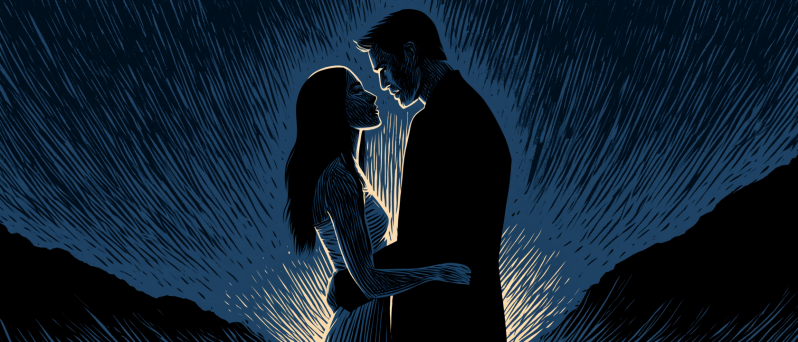
That night, I loved her more
desperately than ever. She gave me
everything in return.
Words fail me, even now, to describe
what I felt. There’s no word for it.
I’ve never felt so close to the divine,
though I believed in no higher power.
At dawn, her radiance returned, softer
now. I’d grown used to it since the
forest.
I fell asleep. When I woke, she was gone,
irrevocably. A note lay on my bedside
table:
“Louvre, Paris, today in a year -
afternoon, Aurora.”
That year devoured me. Her absence
gnawed at my soul. Some days, I
couldn’t leave my bed.
I missed her endlessly. After weeks of
hope and dread, I knew she wasn’t
coming back. It broke me.
I puzzled over her cryptic note, finding
no answers. I swore I wouldn’t go to
Paris.
But as the day neared, I craved closure.
So I went, standing before the Louvre,
heart pounding, torn by fear. Would I
wait? Would she come? Had she
forgotten me?
A small sign caught my eye. In a trance,
I followed it. A special exhibition:
Aurora.
A strange feeling gripped me. Could
this be chance? Everything about her
had always been strange, unreal.
I reached the exhibition and saw the
painting from afar. Aurora. My Aurora.
My heart stopped.
It was impossible. Yet there she was. A
woman, draped in white, her upper
body bare.
Dark hair cascaded down her back.
She held a lily with grace. I stepped
closer, feverish, but the image held.
The averted face, the long hair, the
gentle curve of her belly, it was her.
I stared at the plaque: “William-Adolphe
Bouguereau, L’Aurore, 1881.” I was
unraveling.
Tears spilled down my cheeks,
unbidden. All my grief, my love, my
loneliness, my longing, it overwhelmed
me.
I wept, heedless of the world. A gentle
touch on my arm. I looked up, dazed,
into green eyes.
A woman asked if I was okay. For a
moment, I hoped it was Aurora. It
wasn’t. Yet she looked like her,
shorter hair, fuller lips, but the same
expression. Her eyes, though, were
Aurora’s, and I stared, lost.
My thoughts dissolved. She led me to a
bench, brought me water. I was grateful
not to be alone.
I tried to breathe, slow and steady.
“1881” echoed in my mind. She spoke,
her voice soothing, cedarwood-rich.
I wondered if losing Aurora had driven
me mad. Then she, Celine, said
something that chilled me:
“This painting shows one of my
ancestors. It’s been in our family for
ages.” I couldn’t process it.
Celine, oblivious to my turmoil,
explained. Her ancestor, the painter’s
secret lover, was painted as Aurora,
the Greek goddess of dawn. She spoke
of Aurora loving the god of twilight,
destined to meet only rarely.
In myths, they were the moon and sun,
seen together only at dawn or dusk.
“A beautiful allegory,”
Celine said, smiling. “The painter’s lover
was truly named Aurora. I hope she
found happiness with her twilight god.”
Nothing made sense. Yet, in a terrifying
way, it all did. Later, at my hotel bar, I
waited for Celine.
We’d agreed to dinner, maybe because
of her kindness, maybe because she
resembled Aurora, or maybe because I
couldn’t bear to be alone. A hotel
employee handed me a note.
Aurora’s flowing script: “Sometimes a
heart must learn to love before it’s
ready to follow its destiny.
With love, Aurora.”
I swallowed hard, eyes scanning the
bar. There she was, with a man. I knew
instantly who he was.
Taller, his face half-hidden in the dim
light, but his eyes, proud, majestic, met
mine.
His arm rested on her waist. He turned,
gazing into her eyes.
Only I saw the unearthly light that
flared between them. It stole my breath.
The dawn and the twilight.
No doubt remained. Aurora looked at
me, winked, and smiled. He nodded, a
brief acknowledgment, and kissed her
forehead. They walked out, radiant in
the evening’s glow, entwined.
I knew I’d never see her again.
I still can’t make sense of it. My mind
recoils from the staggering truth, yet
Aurora lingers in my thoughts.
Celine, now my wife, whom I love, knows
none of this.
Nor that I sometimes think of Aurora,
missing her. She believes chance
brought us together at the Louvre.
My wine glass is empty now. My wife’s
voice pulls me from my reverie. She
takes my hands, placing them on her
growing belly. “It’s moving,” she laughs.
“Can you feel it?”
I stroke her belly, and suddenly, she
shimmers, just as Aurora did years ago.
I stare, startled, but she seems
unchanged, unaware of the light. It
radiates from her core.
As if reading my mind, she says, “If it’s a
girl, we’ll name her Aurora.”
I nod, speechless, for in my mind, a
cedarwood voice speaks clearly:
“Sometimes our descendants carry
special gifts. They need those who’ve
been loved by the gods.”

Well.
He never understood Aurora.
Not entirely.
He tried.
He was a journalist, after all.
Unfortunately, some truths are
remarkably resistant to research.
But he did understand one thing.
Eventually.
Love.
Before Aurora, it was something he
thought he understood.
After her, it was something he was capable of.
There is a difference.
She opened something in him.
Then left.
Not particularly kind.
Possibly necessary.
The gods have never been especially
reliable when it comes to explaining
their methods.
And now life continues.
A woman he loves.
A child on the way.
A name already waiting.
Aurora.
And one rather curious message about
descendants.
Gifts.
Those who have been loved by the
gods.
He doesn't understand that part.
Neither do we.
Not yet.
But perhaps you've noticed something
by now.
Cassandra's story contains rather a lot
of things that seem to have begun
before she arrived.
We'll leave it at that.
